
Outages, Incentives, and the Rise of the Home Energy Ecosystem
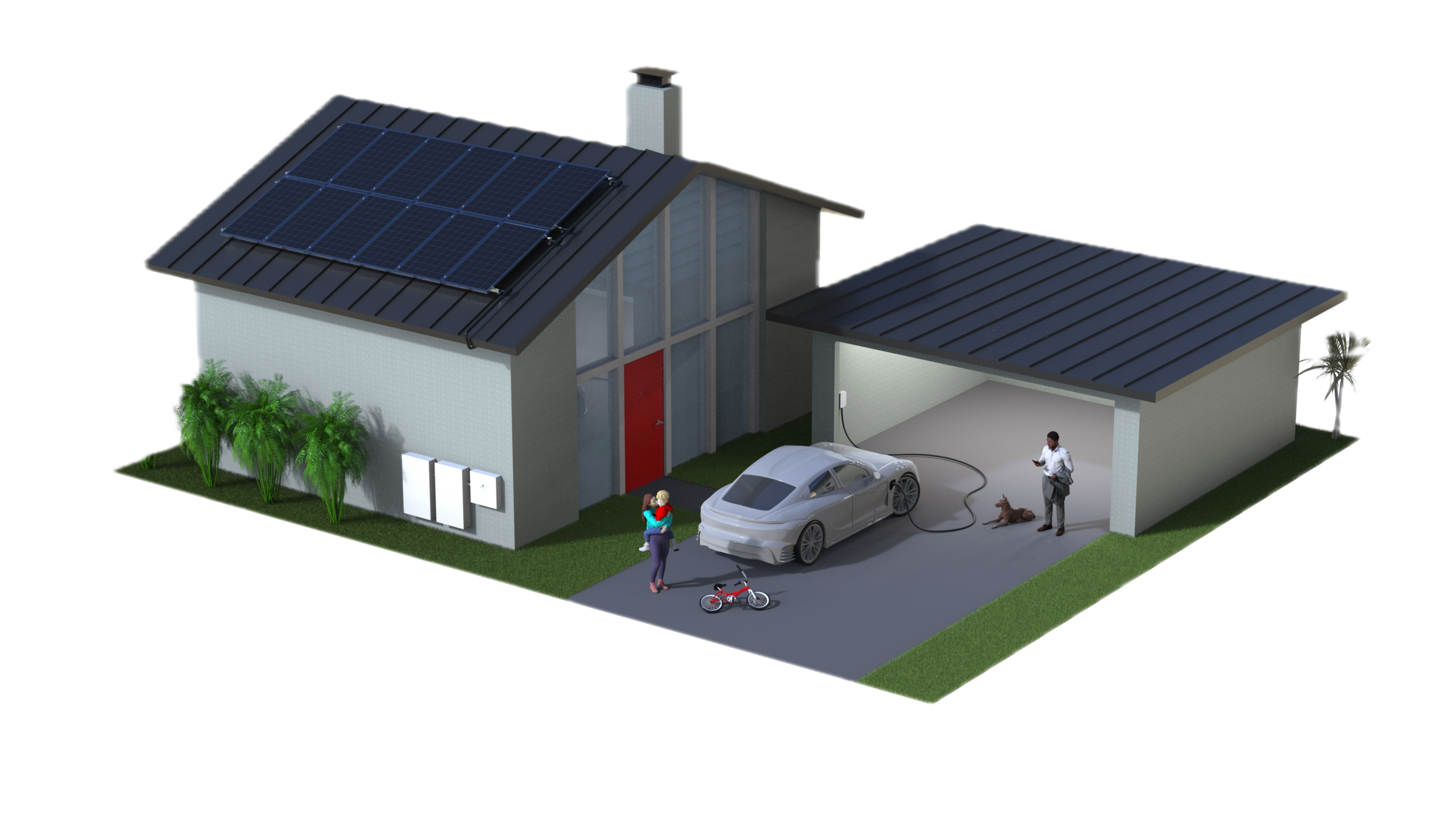
Half a century after the inception of home solar the home energy market is undergoing a profound revolution. Improvements in solar and battery technology, combined with growing demand and increasing grid instability, mean that the traditional centralized energy model of delivering residential electricity must give way to a new, distributed, more resilient approach.
A close analysis of multiple current trends tells us that, rather than simply remaining customers of power utilities, solar-powered homes will evolve into a “home energy ecosystem” that is itself essential to grid infrastructure. The shift toward this new model, already underway, can be broken roughly into three phases.
Phase One: Big savings, doing good -- and a new problem
The first phase of home energy transformation was defined by the programs and policies that made residential solar financially viable. In this early market, customers were credited at the full retail electricity rate for the excess power they sent back to the grid, virtually guaranteeing a home solar system could be paid off in as little as five to seven years. By aligning these substantial savings with homeowners’ sociological desire to “do good” by embracing renewable energy, phase one policies like Net Energy Metering in California and Australia’s feed-in tariffs achieved their primary goal: the mass adoption of solar technology.
These efforts were wildly successful, reducing peak loads in California by about 30 percent and handling 15 to 20 percent of peak loads in Queensland during summer heat waves. But they were also the direct catalyst for a new problem: the “duck curve.”
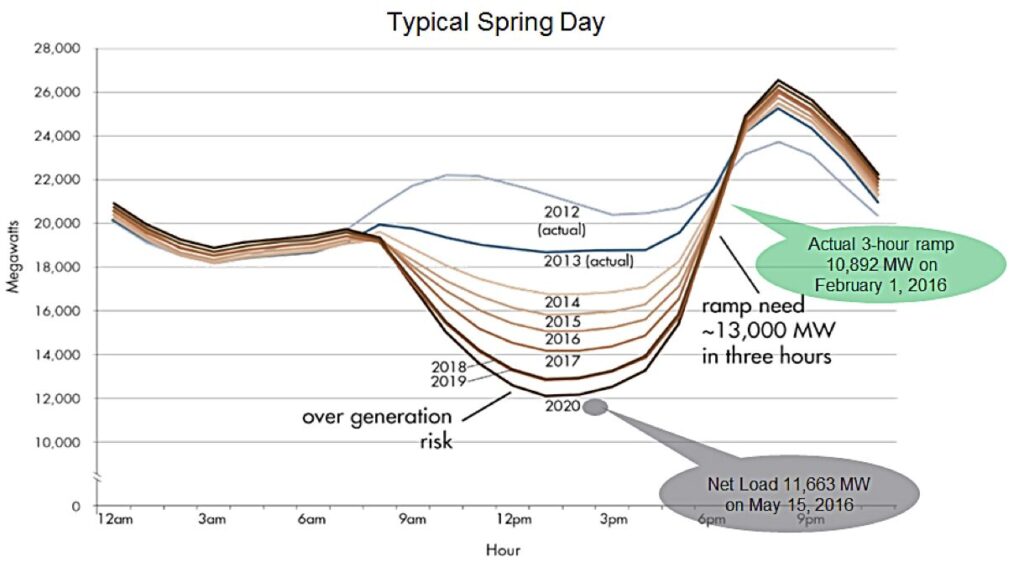
Duck Curve: Graph of energy use net of solar/wind generation. Source: California ISO
By paying homeowners to export maximum power during the middle of the day and offering no financial reason to store it — rewarding total energy volume rather than tying its value to time-of-use — such policies created a deep midday "belly" in the electricity supply curve that has threatened grid stability ever since. In California, the NEM 1.0 and 2.0 incentive structure encouraged customers to use the grid as a free, infinite battery. Premium feed-in tariffs in Australia, which paid as much as 60 cents per kWh, had a similar effect, and still regularly push grid demand into negative territory in the middle of the day.
Phase Two: The storage inflection point
Regulatory changes to address the duck curve and other issues dismantled the economic case for solar-only systems, extending payback timelines to over a decade and bringing an end to phase one. The market is now firmly entrenched in phase two, characterized by the near-mandatory addition of battery storage to solar installations.
For solar-plus-storage systems, the economics have remained compelling in many markets, with payback periods of around seven to nine years. The value proposition now centers on self-consumption: Homeowners can store solar energy gathered during the day and use it during high-cost evening peak hours.
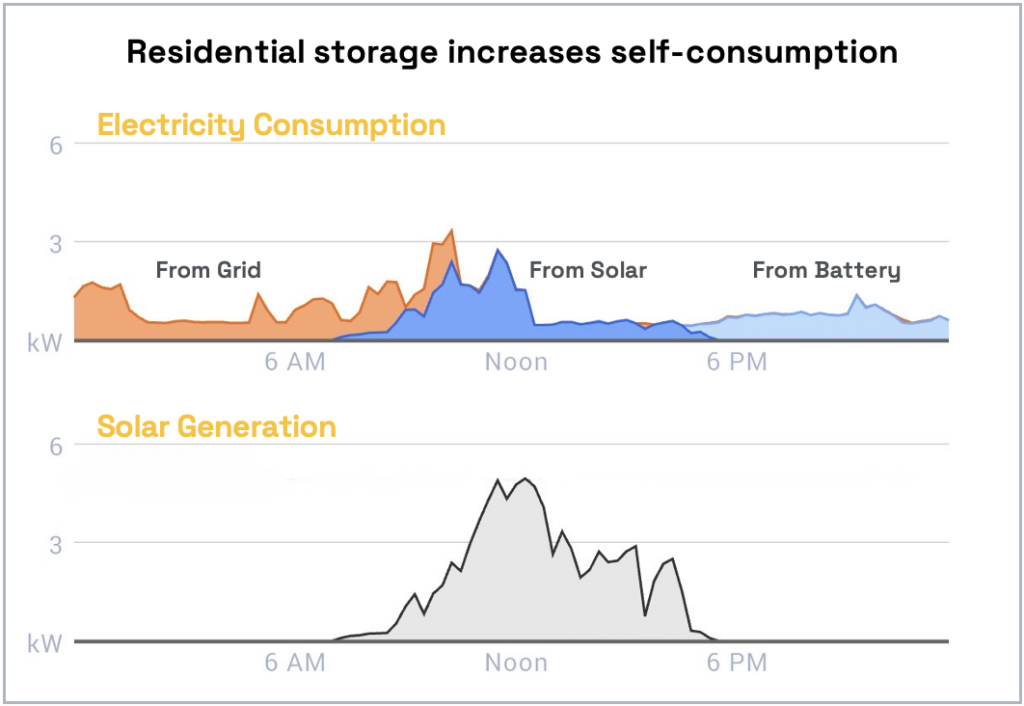
Source: A residential solar and storage system in California, 2/7/26.
Furthermore, as the increasing frequency of extreme weather events has made grid outages more common, resiliency has become a major driver of solar-plus-storage adoption, particularly in regions like Texas, Florida, and the northeastern United States. Consequently, battery attachment rates to new solar installations have soared, in some markets reaching 50 percent or more.
Stormentum research: What’s driving battery adoption now
A summary of key battery adoption drivers by Stormentum confirms that the economic viability and practical necessity of residential energy storage are the primary factors behind increasing residential storage installation rates.
Stormentum analyzed a dozen factors related to battery adoption. The calculated score values below represent the weighted influence of each of these several factors on the increasing installation of residential energy storage, with higher values indicating a stronger correlation and impact:
Strong Determinants (Weight ≥ 0.180): Factors with weights above 0.180 are the most potent drivers.
-
- Storage Incentives (0.240) are the strongest single determinant, underscoring that direct economic policy is the primary accelerator of storage installation.
- Outage Reliability (0.180) is the next most powerful driver, indicating that consumer response to frequent grid failures is a major contributing factor to adoption.
Moderate Determinants (0.110 < Weight < 0.180): These factors have a measurable, although moderate influence.
-
- Battery Attachment Rate (0.150) to solar shows that market changes within the solar market are moderate influences.
- Net Metering Phase-outs (0.130) and DG Penetration (0.120) are closely aligned and represent reimbursement policy change and solar adoption as a market readiness influence, respectively.
- Future VPP Potential (0.110) indicates a moderate correlation with anticipated virtual power plant (VPP) grid policy and utility engagement.
Weak Determinant (Weight ≤ 0.100): One variable falls into this category:
-
- Order-to-Install Days (0.070). While installation efficiency is a positive market indicator, its coefficient suggests it has a comparatively weak direct influence on storage installation growth compared to the more dominant economic, regulatory, and reliability-based drivers.
We analyzed these factors across US states to determine each states' propensity to deploy residential storage in comparison to actual deployments:1

In the chart above, the state-level composite scores, scaled from 0 to 1, represent past and near-term propensity of a particular state to have larger penetration increases in residential storage, either with or without solar.
This analysis confirms that the strength of determination to install home storage is correlated with actual storage installs, and skews toward immediate economic benefits and grid reliability concerns.
Phase Three: The home energy ecosystem
The uptick in residential battery storage is fundamentally redefining the home/grid dynamic, elevating homeowners from passive consumers to active prosumers whose role has become necessary for grid stability. Moreover, this integration into the grid through virtual power plants (VPPs) not only supports voltage control and decarbonization, but also creates viable revenue streams that offset home equipment costs.
Four key forces will drive the market’s movement into the next phase, in which the integrated solar-plus-storage system evolves into a more comprehensive “home energy solution”:
1. Broader home electrification:
As more households adopt electric vehicles and heat pumps, demand for electricity and reliability will increase, requiring larger solar systems and smarter battery management to meet the higher load, to keep power on and residential energy costs under control.
The collision of electrification with increasing storms and outages
As electrification progresses, the "cost" of a power outage rises dramatically — shifting from a mere inconvenience to a complete loss of mobility and heating. This vulnerability, when triggered by increasing storm or public safety outages, is directly correlating with spikes in battery attachment rates.
2. Grid services:
Research published by BloombergNEF, SEIA and others shows how prosumer households using solar-plus-storage serve as stabilizing agents, shifting the load and reducing grid reliance during peak congestion windows. As home batteries are increasingly aggregated into VPPs, homeowners will be able participate in revenue-generating programs that stabilize the grid during peak demand or scarcity events.
For example, Australian homeowners with battery storage earn money by participating in the National Electricity Market through VPPs via the following grid services to support power system management:
- Energy Arbitrage, where batteries buy electricity when prices are low and sell when prices are high, makes up about 40% of total compensation.
- Frequency Control Ancillary Services (FCAS), which helps maintain grid stability and reliability, contributes around 30% of total compensation.
- Demand Response, using stored energy during peak grid stress, makes up approximately 20% of compensation.
- Network Support Services, including voltage control, makes up approximately 10%.
These grid service arrangements with VPP providers earn consumers $15-$40/mo, savings of 10-20% off the electric bill.
3. Favorable economics:
The ongoing drop in battery equipment costs — will make solar-plus-storage more affordable, while persistent grid challenges will increase retail electricity rates. According to multiple studies and reports, utilities’ investments in replacing aging equipment and modernizing the grid are the primary driver of the higher electric bills, and are unlikely to subside in the near term.
4. Decoupling subsidies and price:
As solar and storage achieve competitive pricing, the market will rely less on large initial subsidies and more on the long-term economic tradeoff between rising utility prices and outage inconvenience with reliable decentralized generation, establishing home energy systems as standard home appliances rather than a niche, incentivized luxury.
This will bring us into phase three, when fully integrated distributed solar generation, battery storage, and smart energy management systems aren’t just offering less expensive electricity or backup power, but have become a crucial component of a modern, resilient energy system for residents and businesses. With this vision to guide us, the goal now is to accelerate the realization of the affordable, reliable home energy system.
About Stormentum and home energy independence
Stormentum is accelerating energy independence by helping solar and home energy installers provide storage-first systems that homeowners can actually afford. Its Cellular Inverter system cuts hardware costs by 50%, works with the widest range of third-party batteries, and reduces total system costs by up to 30%. Unlike legacy solar that backfeeds to the grid or proprietary battery platforms that lock installers into costly ecosystems, Stormentum delivers the affordable foundation for storage-first home energy.
To learn more about Stormentum’s solutions, see our technology overview.
Sign up to receive updates on our industry and progress here: