
Keeping the Lights On: Practical Approaches to Residential Backup Power in an Age of Outages
Home backup power is a growing need
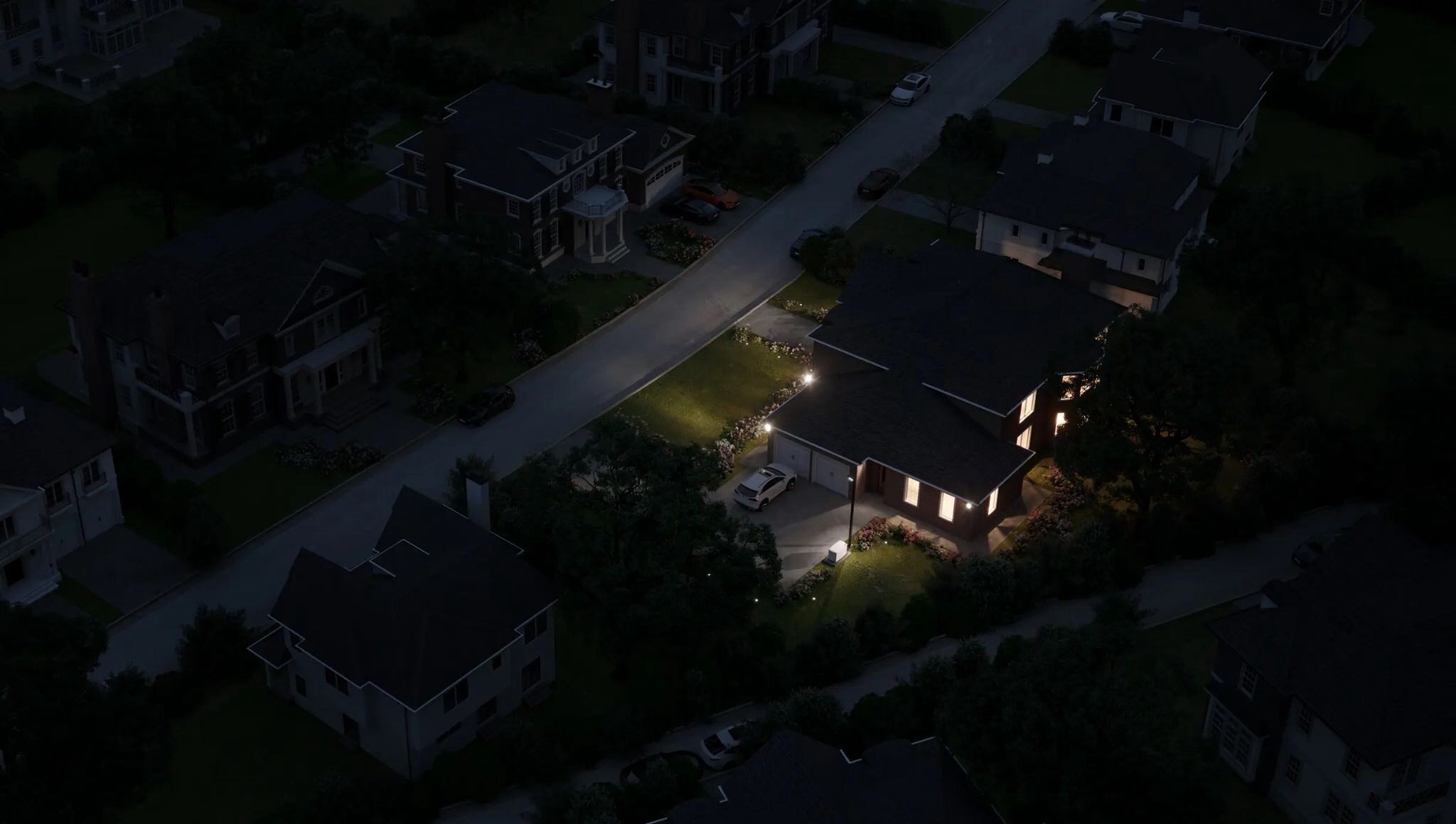
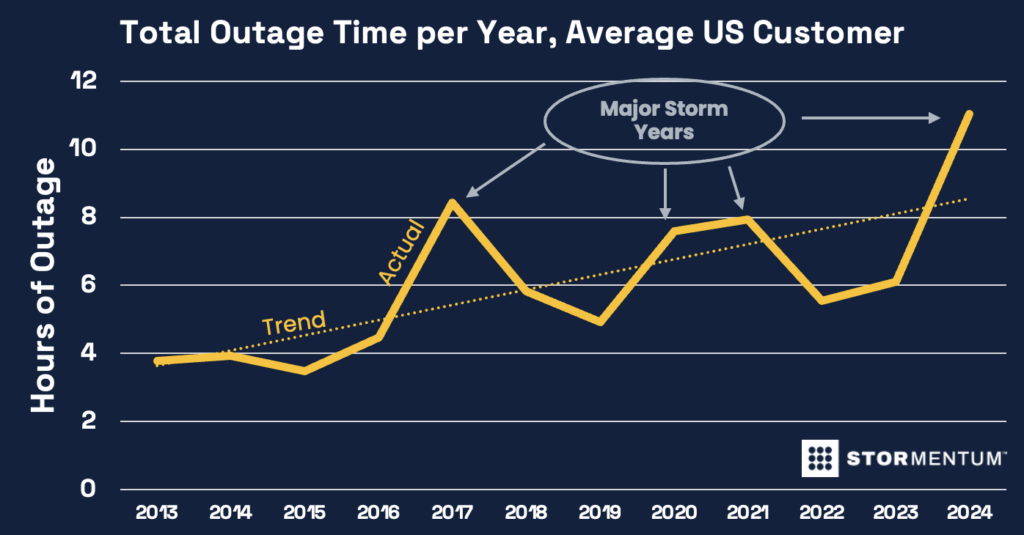
Backup power is becoming a household essential in the U.S. as grid reliability strains under weather and demand. Utilities track reliability with two metrics: SAIDI - System Average Interruption Duration Index, and SAIFI - System Average Interruption Frequency Index. Since 2013, EIA data show a striking trend: the average annual outage time per US customer has more than doubled, rising by about 25 minutes per year.
Source: eia.gov, https://www.eia.gov/electricity/annual/html/epa_11_04.html
While “blue-sky” reliability (excluding major events like storms) has stayed roughly flat at about two hours of outage time per customer annually, total outage time swings widely from year to year with hurricanes, winter storms, wildfires, and other extremes. In recent years, those major events have at least doubled the typical outage duration. This pattern means the everyday grid isn’t collapsing, but the risk is growing — exactly the conditions that make home backup systems more valuable.
Weather is the main culprit causing growing power outages
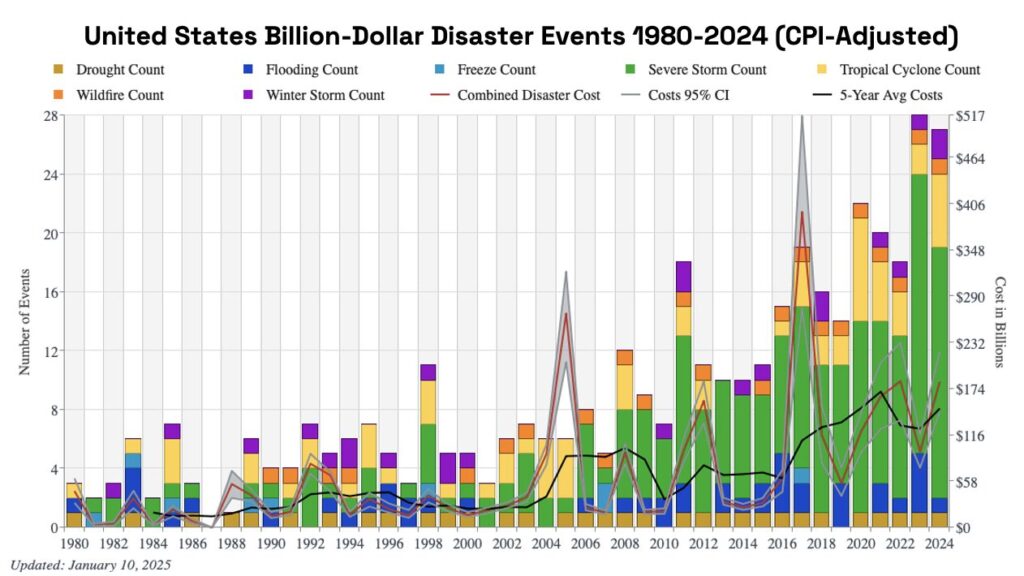
Major disasters—particularly severe weather-driven storms—are the dominant catalyst behind rising U.S. power outages. These hazards inflict direct damage on poles, wires, substations, and generation assets; block crew access; and create restoration bottlenecks that lengthen blackout durations across entire regions. NOAA’s National Centers for Environmental Information maintains the U.S. Billion-Dollar Weather and Climate Disasters dataset, which catalogs the nation’s costliest weather and climate events by peril type since 1980, including tropical cyclones, severe local storms, winter storms, drought and heat waves, inland floods, wildfires, and freezes. This record shows a pronounced escalation in high-impact disaster activity: 403 events occurred from 1980–2024, and the long-term annual average of about 9 events has surged to an average of 23 per year during 2020–2024.
Source: NOAA National Centers for Environmental Information (NCEI) U.S. Billion-Dollar Weather and Climate Disasters
As the frequency and geographic reach of these billion-dollar events expand, electric infrastructures face more exposure to wind, ice, fire, and water—exactly the failure modes that trigger widespread, multi-day blackouts. In short, the grid’s baseline performance on calm days tells only part of the story; it is the growing cadence of extreme, disaster-scale weather that now sets outage risk. For households, that makes backup power a more important layer of resilience and preparedness.
For major disasters, electric outages can last for days. For example, during the Uri storm in Texas in 2021, households in Houston reported outages ranging from 1 hour to 5 days, with the average outage lasting 46 hours (almost 2 days).
What’s a homeowner to do? The main options for backup power for the home
When faced with a 24-hour electricity outage, issues can cascade quickly: lighting doesn’t work, leaving residents in the dark at night; refrigerators warm, risking food spoilage; HVAC stops, bringing heat stress in summer or frozen pipes in winter. Electric water heaters go cold (newer ones may stay warm for ~1 day); gas furnaces and stoves with electronic igniters won’t run. Sump pumps can’t prevent basement flooding. Internet, Wi-Fi, and cable fail, limiting work, school, and emergency updates; phones die without charging. Medical devices and refrigerated medications face interruption. Garage doors, security systems, and exterior lighting go offline. If on a well, water pumps stall, cutting water and toilet flushing.
Given these issues, more people look for solutions. The primary options for consumers to address power outages are:
Portable generators (gas/propane):
One of the more affordable options, a portable generator can typically generate 3–8 kW, enough to run refrigerators, Internet, lights, and charge phones. Power can be provided by placing the portable generator outside and powering equipment via cords or a manual transfer switch/interlock to your home electrical system. Key issues: Carbon monoxide (CO) safety is paramount, according to the CDC, about 100 people per year die, and thousands are injured from CO poisoning from improper use of a generator. Maintenance and fuel storage are ongoing tasks, even when not in use.
Portable power stations (with or without solar power bank):
With storage capacities up to 4 kWh and powering up to 6 kW, portable power stations powered by batteries are quiet, fume-free, and safe to use indoors, making them ideal for apartments or room-by-room backup. They require little maintenance, start instantly, deliver clean power for electronics, and can recharge from wall outlets, car ports, or portable solar. App controls and modular expansion add flexibility. The downsides are limited capacity and inverter output restrict heavy loads like central HVAC, well pumps, and electric ranges. They run out of charge, meaning long outages demand sun+solar panels or grid access to recharge. There can be fire risk with lithium batteries, particularly if they are damaged or overcharged.
Whole home generators (NG/propane):
Permanently installed standby whole-home generators can provide 10–26 kW, enough for whole-home or all the critical loads of a house. Air-cooled generators with an automatic transfer switch can automatically detect outages and start within a few seconds, and can run on existing natural gas line or from a separate propane tank. Annual maintenance and regular checks of oil level are required. Piped natural gas is generally quite reliable, however, during Texas’s Uri storm ~25% of Houston residents also lost their piped gas service.
Home battery storage (with or without solar):
A whole-home backup battery offers silent, emission-free 10-20 kWh+ backup capacity with instant switchover, no fuel storage, and minimal maintenance. It pairs well with rooftop solar to recharge during sunny days. Large (or multiple) batteries with solar can operate well for extended outages. Smart controls can prioritize critical circuits and provide app visibility. However, usable capacity limits runtime—large HVAC, electric cooking, well pumps, and EV charging can drain reserves fast. An extra benefit of batteries, while grid-connected and not during outages, is that they can reduce electric bills through time-of-use energy shifting and demand management.
Vehicle-to-home (V2H):
Bidirectional EVs (e.g., F-150 Lightning) can supply ~9.6 kW for days with the right home integration hardware. They provide quiet, emission-free operation, instant switchover through a transfer switch, large usable capacity versus portable or home batteries. Only certain EVs and bidirectional chargers are compatible. Equipment and installation are costly, with permitting, utility approval and proper interlocks that may be required. If the car isn’t home — or you must drive — you’ve lost your backup, but you can drive somewhere to refill/recharge your car battery.
UPS for single circuits/equipment:

Low-cost line-interactive/online Uninterruptible Power Supplies (UPS) can power small loads such as sump pumps, Internet routers, computers, medical devices, gas water heaters. They can also bridge short outages or generator spin-up.
Reliability considerations by backup approach
Of course, homeowners want their electric backup to work when the power goes out - but backup energy reliability varies greatly by source, as illustrated below.
Portable generators are dependable stopgaps if maintained and exercised, but their “reliability” is constrained more by fuel availability and storage than by the machines themselves. Small, air-cooled gasoline gensets typically have design lifetimes of ~250–1,000 operating hours which — at typical outage durations of hours to a few days — covers many events before overhaul or replacement. The biggest availability killer is stale gasoline: Manufacturers warn that fuel can deteriorate in as little as 30 days without stabilizer, leading to hard starts or no starts from gummed carburetors; they recommend stabilizer and specific storage and maintenance procedures after 30–60 days. Extended outages require multiple fuel refills, changing the oil & filter and regular checks of operation.
Portable power stations require no maintenance and are nearly always ready as long as they’re kept charged. Batteries can last 3-10 years and up to 3,000 charge/discharge cycles meaning they can be nearly always ready for outages. The major disadvantage for battery units is their limited energy storage and their need to be recharged during longer outages. External portable solar panels can be purchased to extend their usefulness.
Whole home generators can be more reliable in scenarios where the duration of an outage is uncertain or expected to be very long, for as long as a generator has fuel, it can provide power indefinitely. However, looking at actual “survivability” rates of even robust well-maintained commercial backup generators shows that mechanical breakdowns do happen over extended outages - ie, ~13% breakdown over 4 days of use. Further, major storms can adversely affect fuel availability, even for piped natural gas. As with all mechanical devices, regular maintenance is needed.
Home battery storage systems excel in their instantaneous, seamless performance with minimal intervention. With virtually no moving parts, battery systems minimize the risk of a part failing to start or operate correctly when you need it, and are quiet and produce no harmful emissions. There is flexibility in where they can be installed. However, limited storage means a solar or additional generator system is needed to recharge batteries for extended outages. When paired with solar, home battery systems can recharge when the sun shines and are proving to be more dependable than fuel-based mechanical systems.
Real-world home backup system costs
System costs are a huge factor in the choice of a residential electric backup system. Prices vary dramatically depending on configuration and supplier, the chart below summarizes typical price ranges for each type of system.
The biggest factor driving increased costs for whole-home systems is the installation cost, labor and overhead, which typically represents one-third to one-half of the system cost (see details).
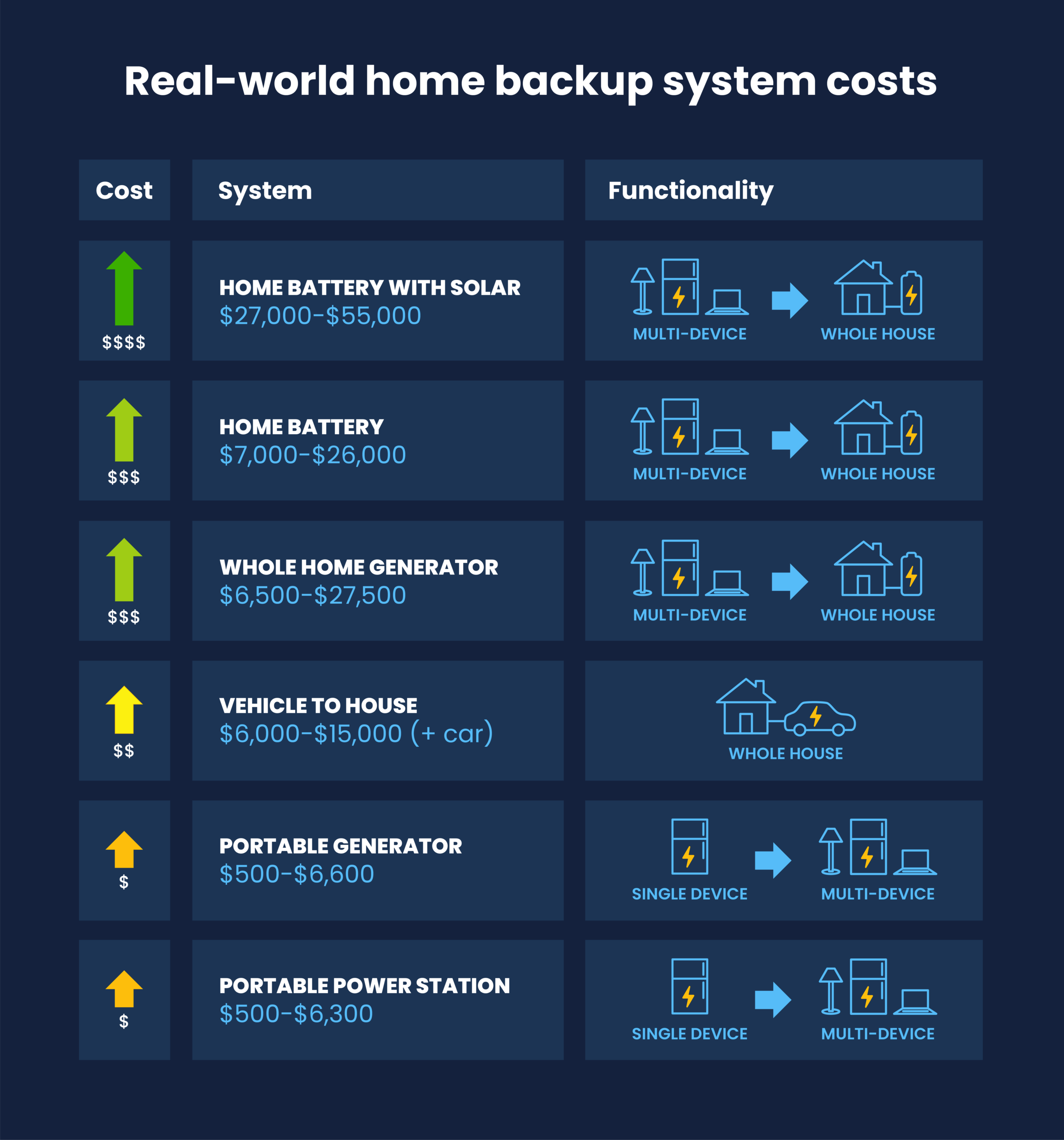
Home backup system costs and functionality comparison
The battery backup premium is probably short-lived
While fully integrated home backup systems are quite expensive when factoring in the hardware and installation costs, the addition of a battery-based option to traditional mechanical generators is starting to show promise. And, when we look at the relentlessly declining costs of high-capacity batteries, there’s reason to believe that over time, battery-based systems will overtake the current cost and storage limitations and become a primary choice for homeowners over mechanical generators.
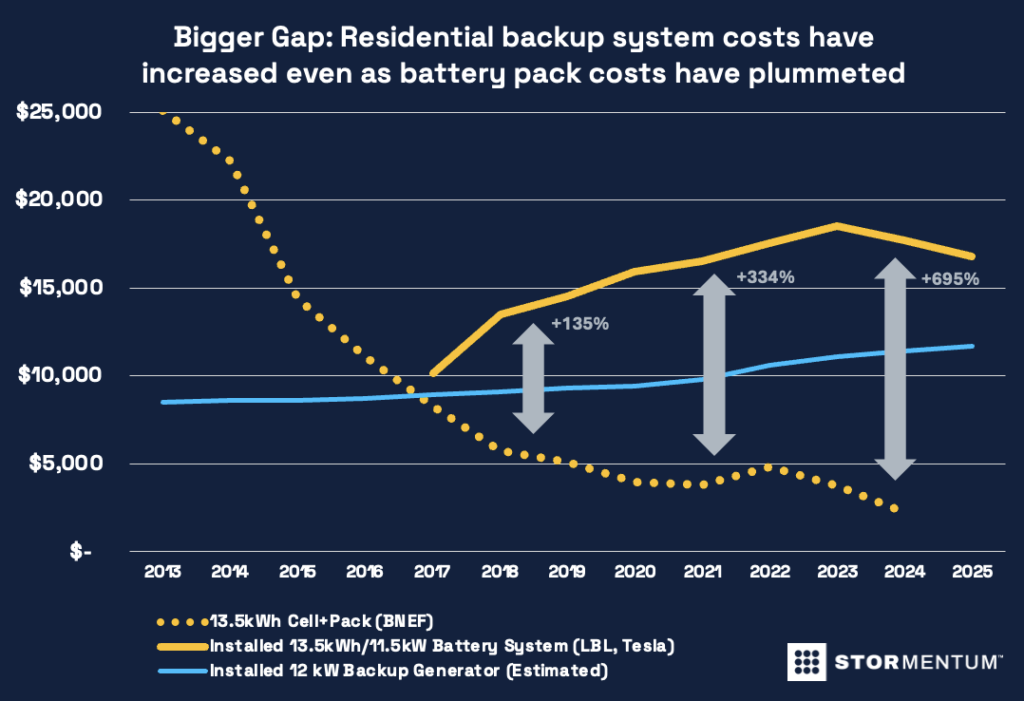
Sources: Bloomberg NEF, 2023 & 2024 Lithium-Ion Battery Pack price reports; Lawrence Berkeley National Laboratory, Tracking the Sun 2024; Tesla.com pricing retrieved 8/2025; Backup Generator pricing estimated from manufacturer websites, archive.org websites.
Given the relentless cost reduction in battery pack systems, the current price-premium seen in the residential battery backup space is likely to be short-lived, as competition, process improvements, and scaling increases. Stormentum is developing technology to help close this price gap, to enable affordable, clean, maintenance-free solutions to homeowners’ energy challenges.
About Stormentum and home energy independence
Stormentum is accelerating energy independence by helping solar and home energy installers provide storage-first systems that homeowners can actually afford. Its Cellular Inverter system cuts hardware costs by 50%, works with the widest range of third-party batteries, and reduces total system costs by up to 30%. Unlike legacy solar that backfeeds to the grid or proprietary battery platforms that lock installers into costly ecosystems, Stormentum delivers the affordable foundation for storage-first home energy.
To learn more about Stormentum’s solutions, see our technology overview.
Sign up to receive updates on our industry and progress here: